



no.11
[Double Eyelid] Incisional Double Eyelid Surgery: How Is It Done?
2025-12-05
Now let's look at how incisional double eyelid surgery is performed.
As I explained before, double eyelid surgery creates a connection between the skin and the deeper structures,
and this method creates that connection through an incision.
An incision is made along the desired line, as shown in the illustration,
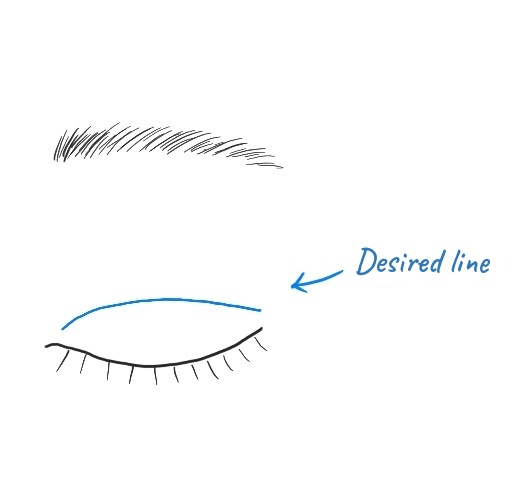
Front view
and to fix the double eyelid in place,
the tarsal plate and the eye-opening muscle are identified.
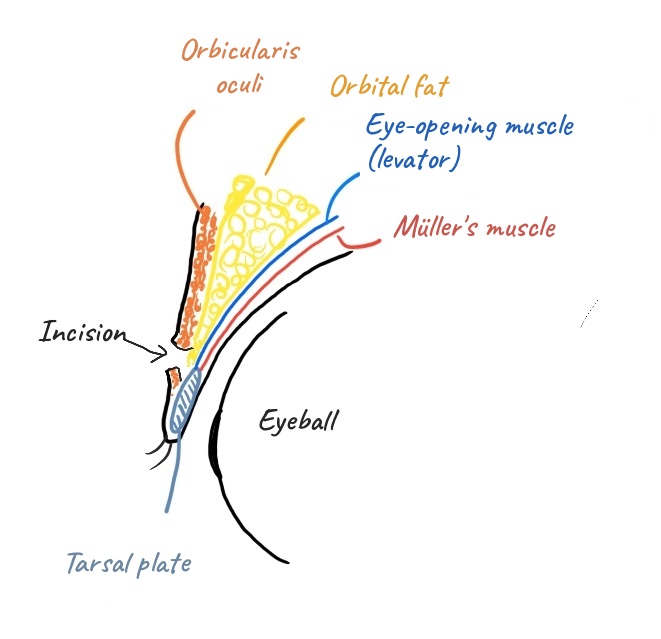
Cross-section, after the incision
As shown, the orbicularis oculi muscle is connected to the tarsal plate,
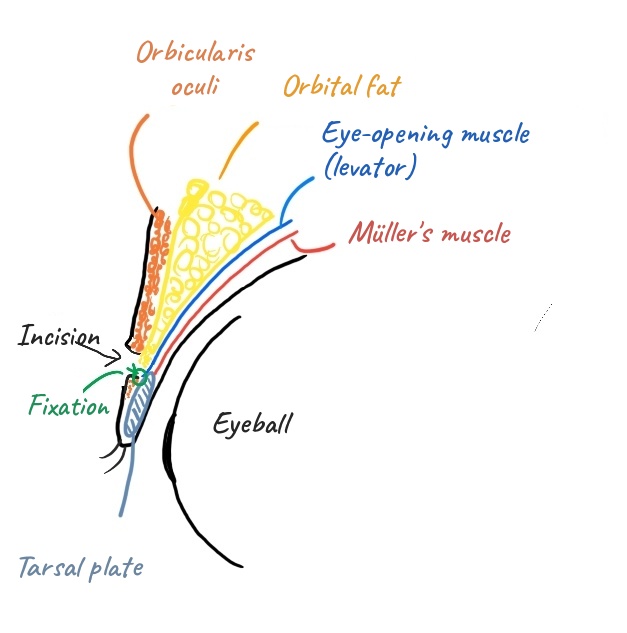
After fixing the orbicularis oculi to the tarsal plate
and once the skin is sutured again,
incisional double eyelid surgery is complete.
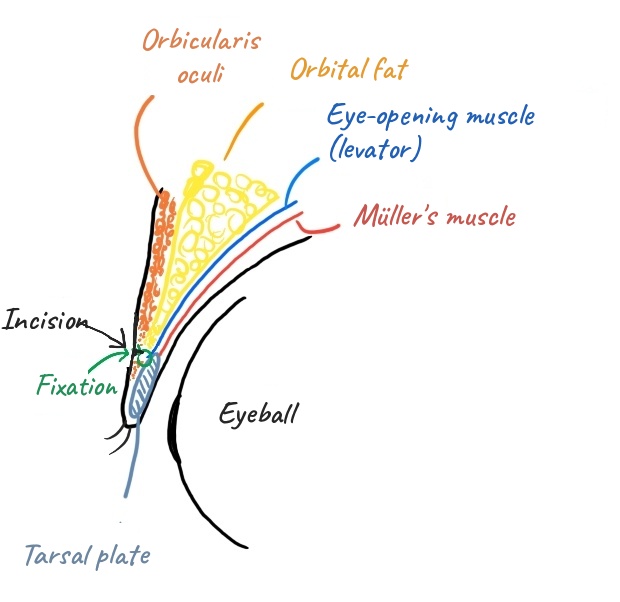
After incisional double eyelid surgery
This is how the connection to the skin I described earlier is created.
When this fixation is placed at several points along the line,
adhesion forms along the incision line,
so a stronger fixation is possible than with the non-incision (suture) method.
When needed, tissues that interfere with forming the double eyelid,
such as fat, pretarsal tissue, and part of the orbicularis oculi muscle, can be removed
to make the fixation even stronger.
Because incisional surgery involves a lot of handling of the eyelid tissue,
swelling and recovery time can vary depending on the surgeon's technique,
and the result is strongly influenced by it as well.
Related posts
▶ The Structure of the Eyelid and How a Double Eyelid Forms
▶ Non-Incision Double Eyelid Surgery: Technique, Principle, Pros and Cons
▶ What Is the Ideal Method of Double Eyelid Surgery?
WhatsApp Inquiries
https://api.whatsapp.com/message/DE3GWE4FQGMDF1?autoload=1&app_absent=0
Sai Plastic Surgery — Phone Inquiries
Main Line: +82-2-512-4647
* This post was written by Dr. Kwang-rae Kang, Director of Sai Plastic Surgery, with his own text and illustrations, for the purpose of providing medical information in compliance with Article 56(1) of the Korean Medical Service Act.