



no.3
[Double Eyelid] Non-Incision Double Eyelid Surgery: Technique, Principle, Pros and Cons
2025-11-13
In this post, we'll look at non-incision (buried suture) double eyelid surgery, which I described earlier as the most ideal approach among double eyelid procedures.
As mentioned before, non-incision surgery surgically creates the same connection between the skin and the tarsal plate (or levator muscle) that people with natural double eyelids already have.
As shown in the illustration, the basic principle is to tie the skin and the tarsal plate together with a suture at the desired line.
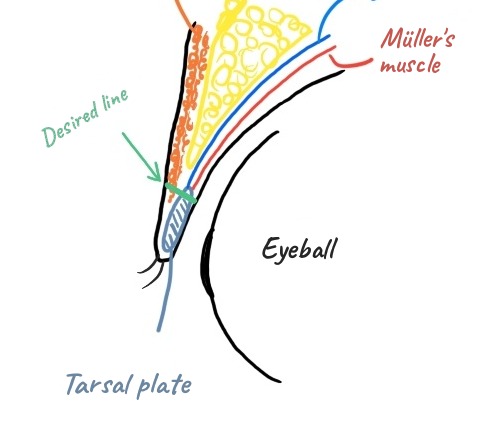
Non-incision surgery creates this connection with a suture through just a few tiny holes in the skin, without any incision.
There are many variations of this technique, and that is why each clinic calls its method by a different name: the details of the technique differ.
Here is the method I mainly use:
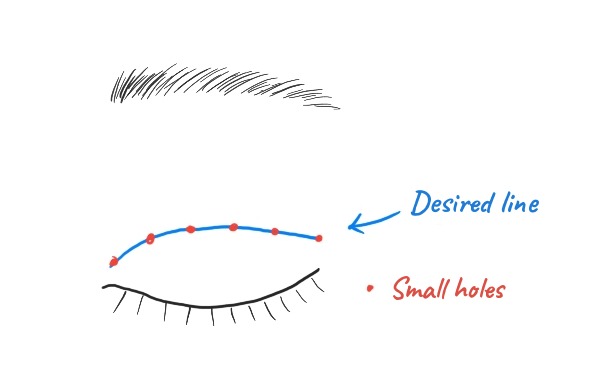
As shown, six tiny holes are made along the desired line,
 |
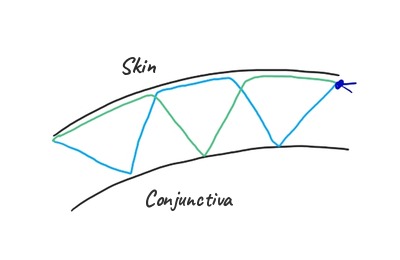 |
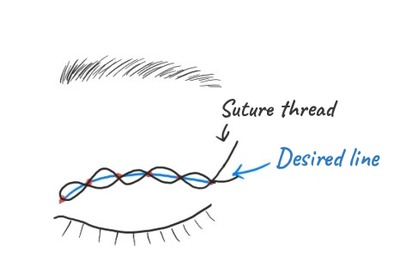
| Left: front view / Right: cross-section | |
and the suture passes between them as if sewing, running under the skin and through the conjunctiva to create the connection.
Because the suture sits beneath the skin, it isn't visible from the outside, and the knot is placed deep inside.
Advantages of this method:
1. No incision, so recovery is fast.
2. The procedure is simple yet precise.
3. With multiple fixation points, the line is less likely to loosen.
And if you are not satisfied with the result,
4. Removing just one knot can return the eyelid to its original state.
However, non-incision methods have one drawback: the line can loosen.
Next time, we'll look at why non-incision double eyelids sometimes come undone.
Sai Plastic Surgery — Phone Inquiries
Main Line: +82-2-512-4647
* This post was written by Dr. Kwang-rae Kang, Director of Sai Plastic Surgery, with his own text and illustrations, for the purpose of providing medical information in compliance with Article 56(1) of the Korean Medical Service Act.