



no.1
[Double Eyelid] The Structure of the Eyelid and How a Double Eyelid Forms
2025-10-23
Patients who come in for a consultation these days have done an impressive amount of research.
Sometimes I'm amazed — "Wow, an ordinary person knows this much?" —
and sometimes it's unfortunate, because the information they've gathered is wrong.
So I'm starting this post to explain the most basic things, slowly, from the beginning.
First, if you understand how a double eyelid forms,
you can understand the surgical methods much more easily and judge what you personally need.
So today, I'd like to briefly explain that basic principle.
Double eyelid surgery is based on research into
the structural difference between people who naturally have a double eyelid and those who don't.
In other words, using the structure of an eye with a double eyelid as a reference,
it is a surgery that artificially creates that structural connection in an eye without a double eyelid.
Simply put, it can be described as the process of creating a 'path' for the double eyelid to form.
The basic structure of the eyelid that you should know is as follows.
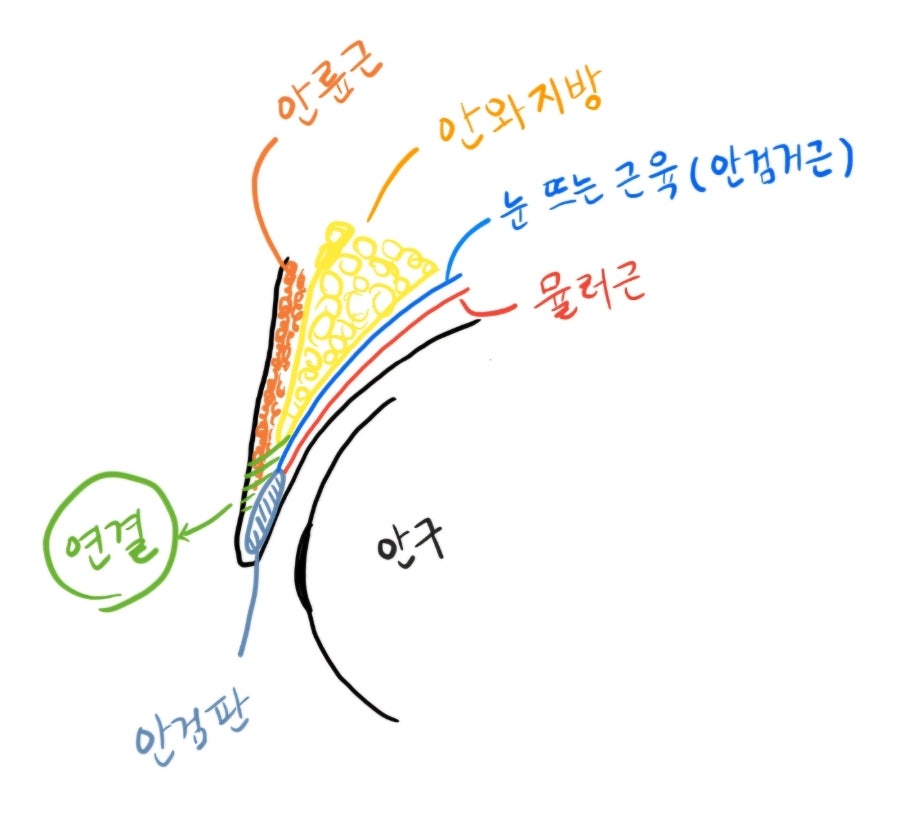
At the edge of the eyelid, just beneath the eyelashes, there is a firm, cartilage-like structure called the *tarsal plate*.
Two muscles, the levator muscle and the Müller's muscle, pull this tarsal plate upward,
and that is how the eye opens.
 |
 |
|
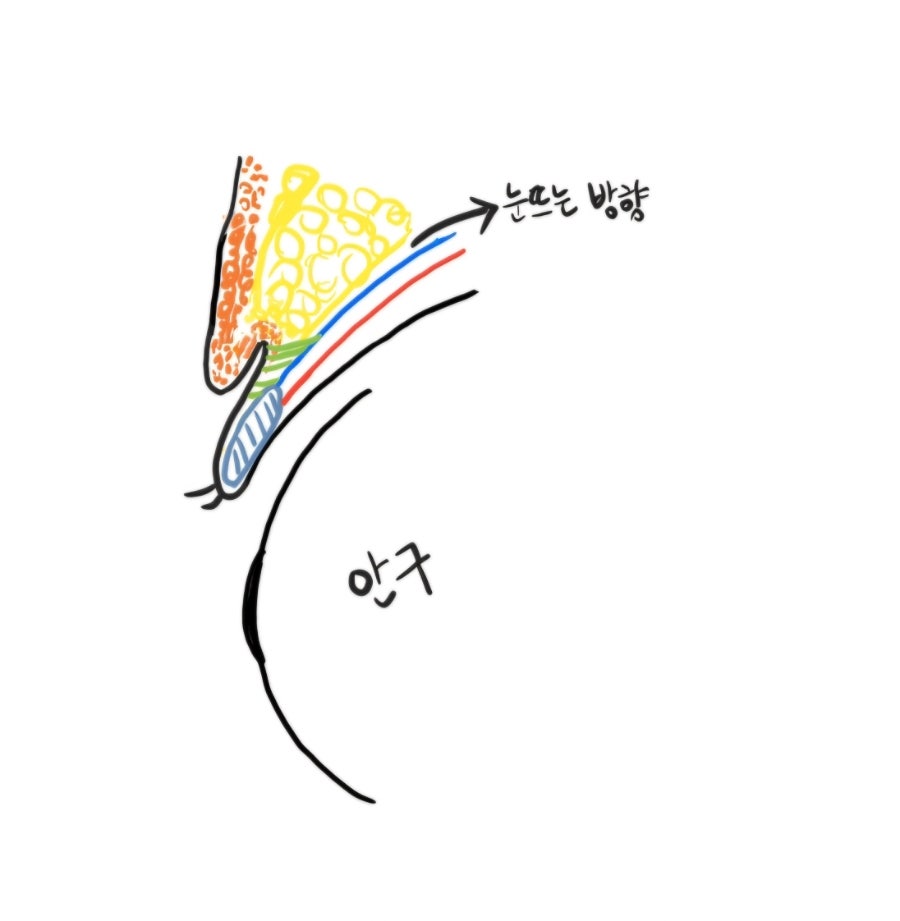
Cross-section of the eyelid and eyeball of a person with a double eyelid, seen from the side (Left) Eye closed / (Right) Eye open |
|
If you look at an eye with a double eyelid in cross-section from the side,
you can see a difference between the closed eye (left) and the open eye (right).
When the eyelid skin folds smoothly inward as the eye opens,
a natural double eyelid is formed.
For this to happen, the skin must be connected to the tarsal plate or the levator muscle underneath.
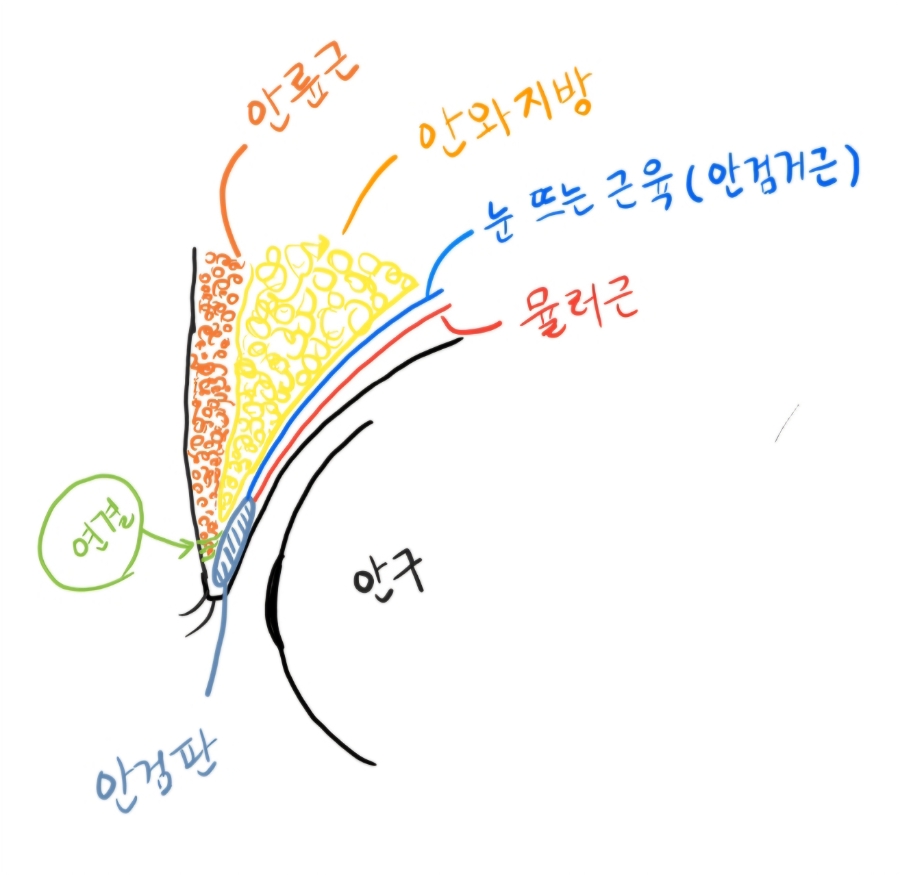 |
| Structure of the Asian eyelid |
However, in Asian eyes,
this connection is often very low, or missing altogether.
That is why hidden (inner) double eyelids and monolids are common.
In addition, the *orbital fat* (the fat that is partially removed during double eyelid surgery) often extends down low,
which interferes with the formation of a double eyelid and makes the eyelid look thick and heavy.
In the end, double eyelid surgery is creating this connection anew at the height you want.
Depending on the method, it can be divided into incisional, non-incisional, or partial-incision techniques,
and, as needed, the orbital fat may be removed,
or ptosis correction, which strengthens the muscles that open the eye (the levator muscle or Müller's muscle), may be performed together.
I've only covered the most basic points.
You don't strictly need to know this, but I believe that knowing it will end up helping you.
In the next post, I'll explain the non-incisional method among them
in a bit more detail, step by step.
Sai Plastic Surgery — Phone Inquiries
Main Line: +82-2-512-4647
* This post was written by Dr. Kwang-rae Kang, Director of Sai Plastic Surgery, with his own text and illustrations, for the purpose of providing medical information in compliance with Article 56(1) of the Korean Medical Service Act.