



no.20
[Double Eyelid] Non-Incisional Ptosis Correction: Method, Pros and Cons
2026-01-05
There are two main methods of ptosis correction:
1. Non-incisional method
2. Incisional method
This time, I will explain the non-incisional method.
Ptosis correction is surgery that strengthens the eye-opening force.
By pulling (shortening) the eye-opening muscle,
it makes the eye open wider when you open your eyes. (See the previous post.)
The muscles that open the eye are:
Levator muscle (levator palpebrae superioris): blue in the illustration
Müller's muscle: red in the illustration
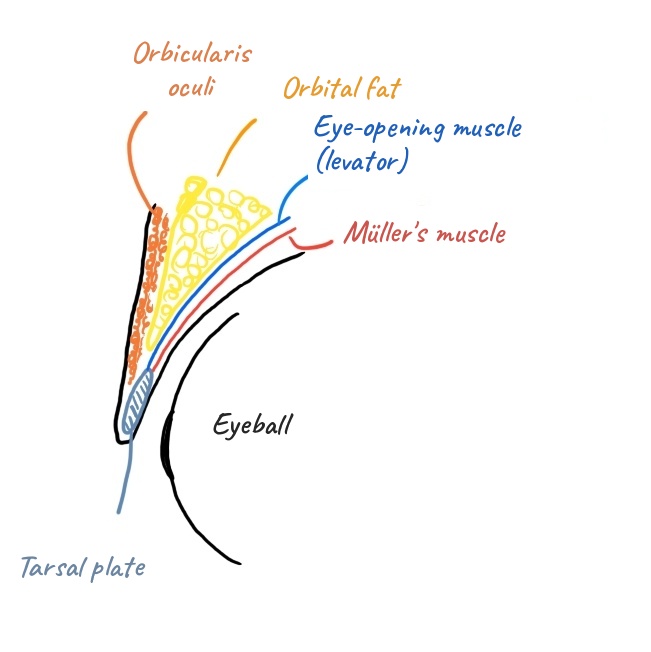
These two.
1. The levator is the muscle that works when we open our eyes intentionally.
(It is a voluntary muscle.)
It is the main muscle, responsible for most of the eye-opening force.
2. Müller's muscle does not move according to our will.
When we are startled or excited, it contracts and opens the eye wider,
and when we are relaxed, it relaxes so the eye opens a little less.
(It is an involuntary muscle controlled by the autonomic nervous system.)
Non-incisional ptosis correction shortens this Müller's muscle
so that the eye can open wider.
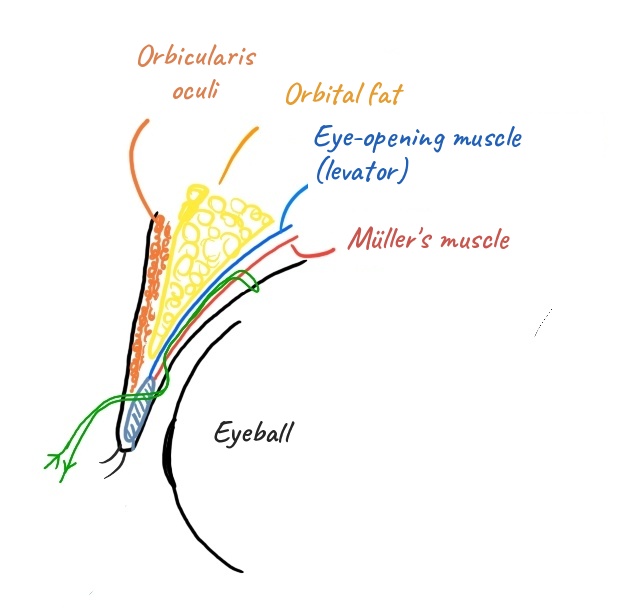
As shown, a suture (green line) is passed in from the outside of the eyelid,
goes to the inner side,
and pulls Müller's muscle to tighten it.
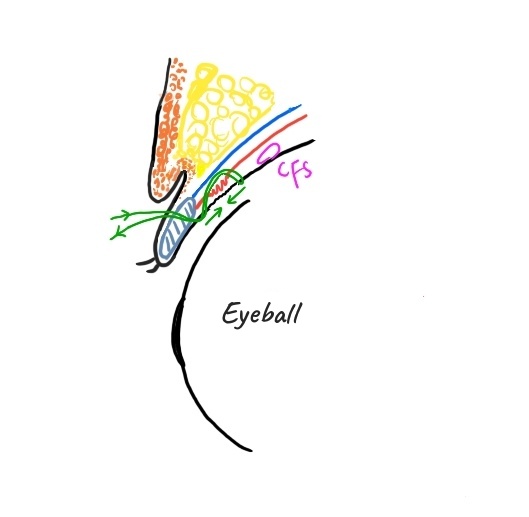
This method is called Müller tucking (plication).
There is also a method that removes part of Müller's muscle altogether.
These days, most surgeons seem to use the tucking method.
I also use this tucking method.
The advantages of this method are:
1. The procedure is simple,
2. It leaves no scar,
3. If the suture is released soon after, the eyelid returns to how it was.
The disadvantages are:
1. There is a limit to how much it can correct,
2. The response varies from person to person,
3. Precise correction is difficult,
4. A side effect called Müller's muscle irritation (very rare).
Among these disadvantages,
regarding the limit on correction,
I consider about 1 mm of correction to be the maximum.
Points 2 and 3 are essentially the same thing,
and point 4, Müller's muscle irritation, is extremely rare,
but when it does occur, it is a difficult side effect to resolve.
Because I believe that correcting to the maximum
with the non-incisional method
increases the risk of Müller's muscle irritation,
I recommend non-incisional ptosis correction
only when the eye-opening force needs just a small correction.
If more than 1 mm of correction is needed,
I explain everything thoroughly and recommend incisional ptosis correction.
◀ Previous post: Who Needs Ptosis Correction (Eye-Opening Surgery)?
WhatsApp Inquiries
https://api.whatsapp.com/message/DE3GWE4FQGMDF1?autoload=1&app_absent=0
Sai Plastic Surgery — Phone Inquiries
Main Line: +82-2-512-4647
* This post was written by Dr. Kwang-rae Kang, Director of Sai Plastic Surgery, with his own text and illustrations, for the purpose of providing medical information in compliance with Article 56(1) of the Korean Medical Service Act.