



no.21
[Double Eyelid] Incisional Ptosis Correction: Technique, Principle, Pros and Cons
2026-01-12
Now let's look at the incisional method of ptosis correction.
Compared with the non-incisional method,
incisional ptosis correction is needed
when the eye-opening force must be strengthened decisively,
in other words, when a larger amount of correction is needed (roughly 1 mm or more).
After making an incision as in incisional double eyelid surgery,
and locating the fat, the levator muscle can be seen beneath it.
To pull this levator, the main eye-opening muscle,
the surgery is performed through an incision.
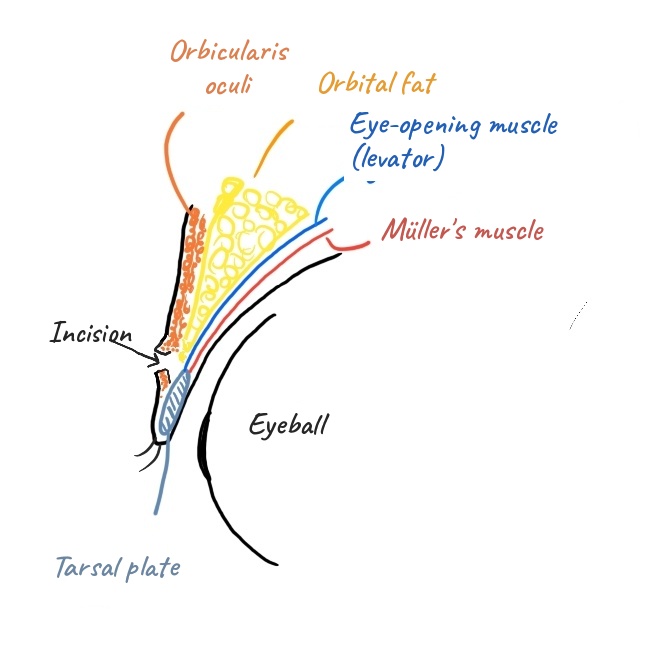
When this levator is pulled and fixed to the tarsal plate below,
the levator becomes shorter,
so that when you open your eyes,
they naturally open wider.
There are several ways
to pull the levator.
Broadly, they can be divided into
1. Plication
2. Advancement
These two categories.
Plication folds the levator
to pull it.
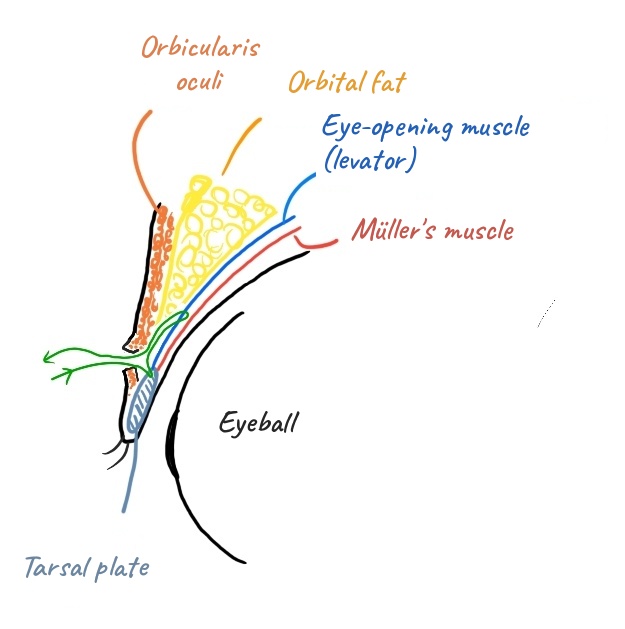
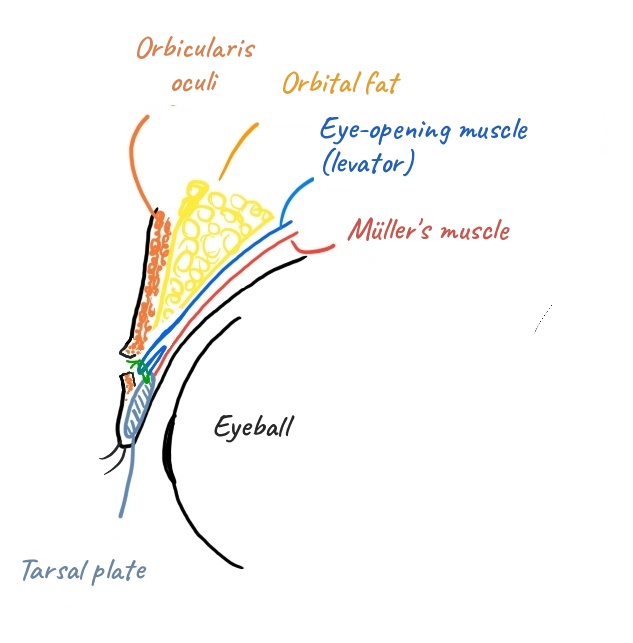
There is the method that folds it outward (supra-aponeurotic plication), as shown here, and
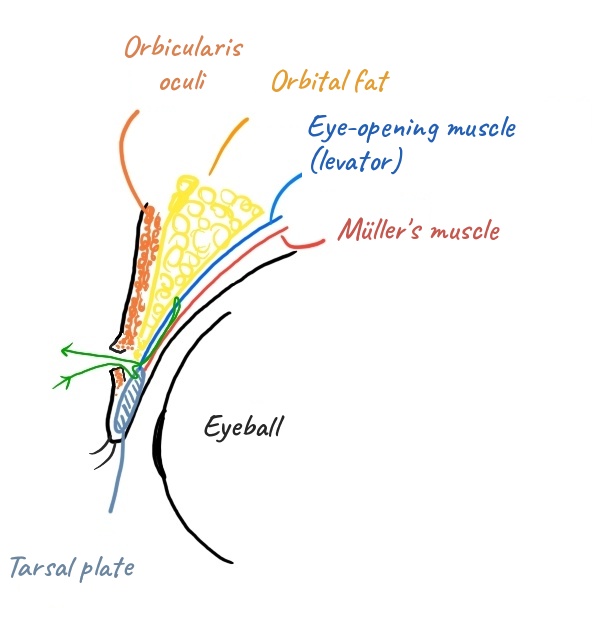
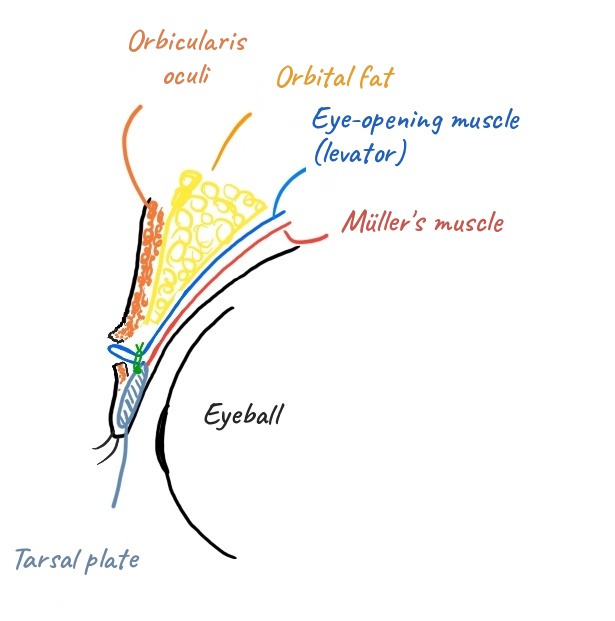
the method that folds it inward (sub-aponeurotic plication), as shown here.
In the illustrations, Müller's muscle is drawn separately,
but in reality it is tightly attached to the levator
and is folded together with it.
2. Advancement, as in the illustrations below,
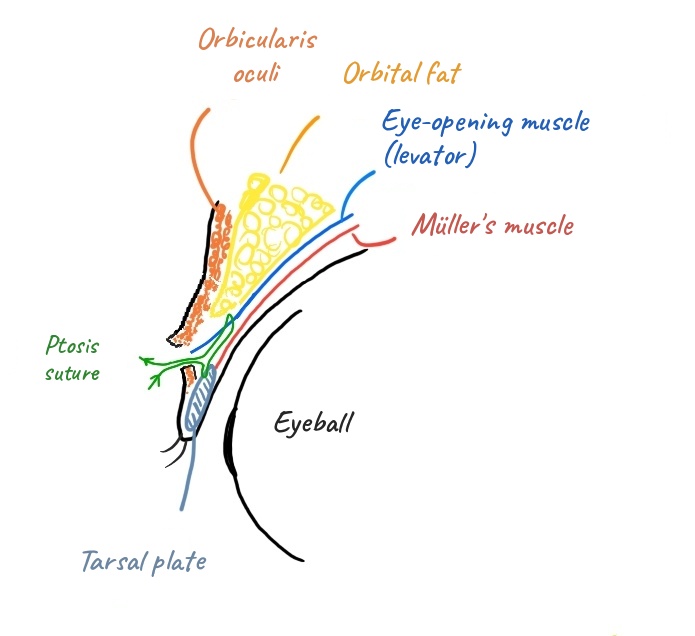
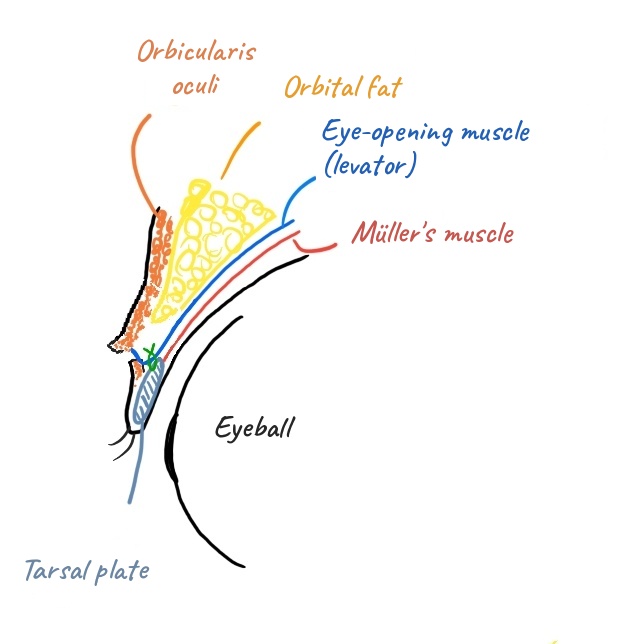
does not fold the muscle;
instead, the levator itself is lifted, pulled forward and fixed.
In this case too, Müller's muscle is slightly folded and pulled along.
Looking at each method's pros and cons:
because plication works by folding,
the bulk of the folded part can get in the way,
and when folding outward,
there is the drawback that less adhesion forms at the folded part.
With advancement,
I dissect and separate the space between Müller's muscle and the levator
up to the desired height,
and then pull it.
That way there is almost no folded bulk to get in the way,
and the adhesion tends to form relatively firmly.
However, there can be bleeding during dissection,
and compared with pulling Müller's muscle together,
the amount of correction is smaller. These are its drawbacks.
That is why I
use the 2nd and 3rd methods above,
sub-aponeurotic plication and advancement,
choosing whichever I judge most appropriate for each case.
Besides the methods I have introduced,
there are many other incisional ptosis correction techniques,
and each has its own pros and cons,
so no single method can be called the best.
Related posts
▶ Who Needs Ptosis Correction (Eye-Opening Surgery)?
▶ Non-Incisional Ptosis Correction: Method, Pros and Cons
WhatsApp Inquiries
https://api.whatsapp.com/message/DE3GWE4FQGMDF1?autoload=1&app_absent=0
Sai Plastic Surgery — Phone Inquiries
Main Line: +82-2-512-4647
* This post was written by Dr. Kwang-rae Kang, Director of Sai Plastic Surgery, with his own text and illustrations, for the purpose of providing medical information in compliance with Article 56(1) of the Korean Medical Service Act.