


no.26
[Double Eyelid] Double Eyelid Revision (1): Raising the Line
2026-02-09
Because double eyelid surgery is so common,
there are a great many people considering revision surgery
because the first surgery went wrong,
the fold came undone over time,
or the skin sagged and made the eyes look smaller than before.
For those considering revision,
I would like to explain the principles behind double eyelid revision
and how the surgery
is performed.
First,
let's talk about cases where the double eyelid has come undone, or where you want to raise the line.
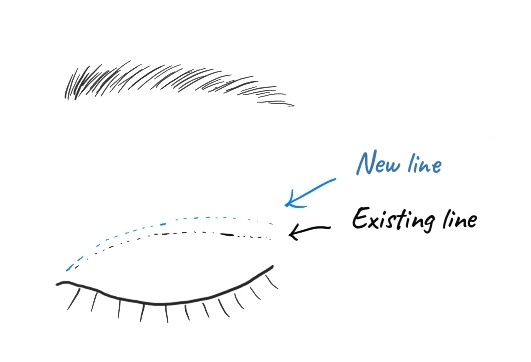
As in the illustration, if you want to raise the line
or re-create a fold that has come undone,
it can be done with the non-incision method.
However, if the desired line is too high
to be held with the non-incision method,
an incision must be made to remove skin.
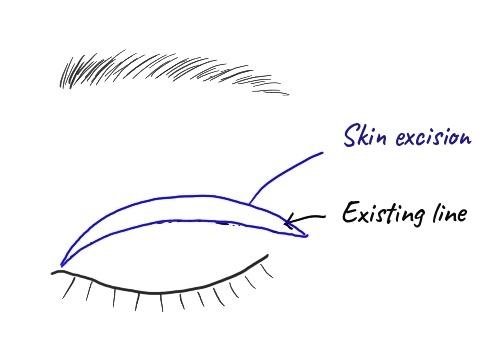
An example of skin excision
People who previously had the non-incision method
can often have the non-incision method again.
For people who previously had the incisional method,
the non-incision method is sometimes possible,
but more often an incision is needed.
Another common worry is
that if a new line is simply created above,
it will look like two lines.
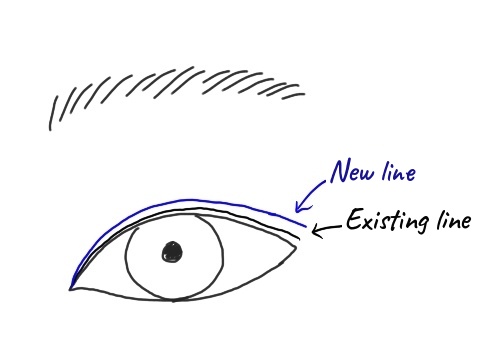
But it doesn't look like two lines like this;
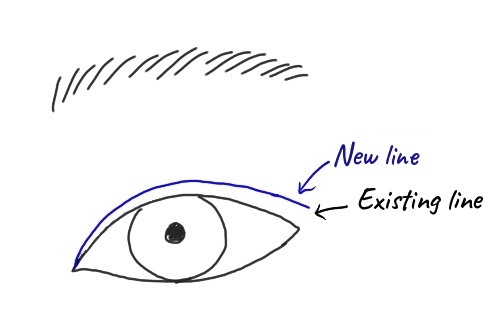
only the new upper line is visible,
and the existing line becomes unnoticeable.
(I like to say the upper line "wins.")
However, if the newly created line comes undone,
the existing line will show again.
In conclusion,
double eyelid revision
does not always require an incision.
However, if you want to lower the line,
an incision is a must.
Next, I will explain
the case of lowering the line.
Related posts
▶ Why Non-Incision Double Eyelids Come Undone
▶ Incisional Double Eyelid Surgery: How Is It Done?
▶ Next post: Double Eyelid Revision (2): Lowering the Line (Double-Line Release)
WhatsApp Inquiries
https://api.whatsapp.com/message/DE3GWE4FQGMDF1?autoload=1&app_absent=0
Sai Plastic Surgery — Phone Inquiries
Main Line: +82-2-512-4647
* This post was written by Dr. Kwang-rae Kang, Director of Sai Plastic Surgery, with his own text and illustrations, for the purpose of providing medical information in compliance with Article 56(1) of the Korean Medical Service Act.