


no.40
[Double Eyelid] Removing Upper Eyelid Fat Without an Incision
2026-04-02
Many people with puffy upper eyelids
want to have fat removed.
In most cases, the fat is removed through an incision.
However, fat removal is entirely possible with a non-incision method as well.
For people whose double eyelid can be created well with the non-incision method
but whose upper eyelids are puffy because of a lot of eyelid fat (orbital fat),
the fat can be drawn right out
through a tiny hole.
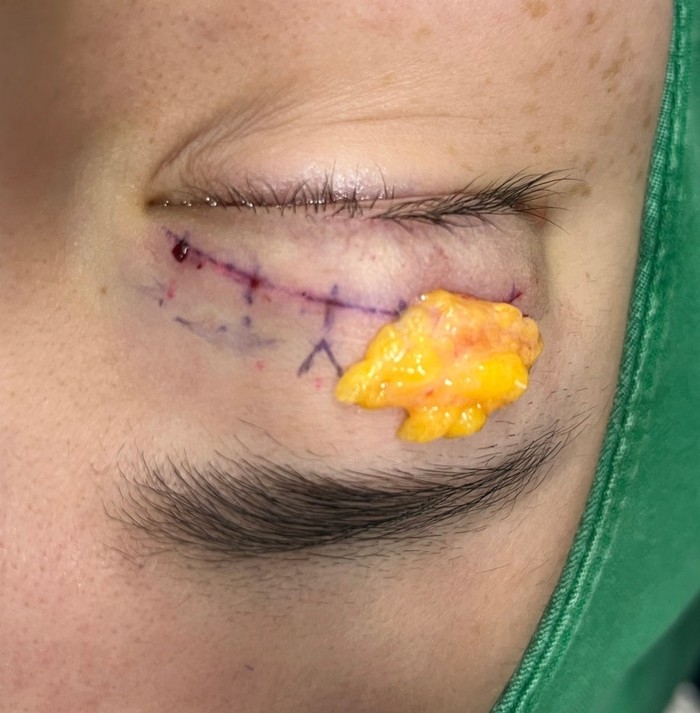
Here is what it looks like in a photo.
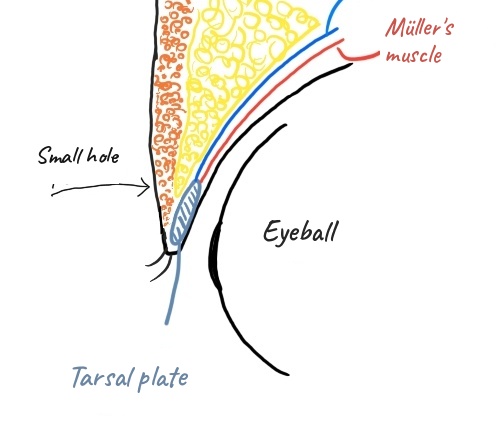
After making a small hole where the line will be created,
we pass through the orbicularis oculi muscle to reach the orbital fat.
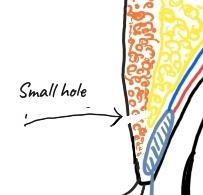
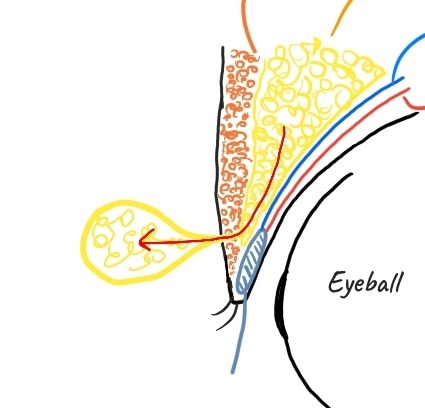
The fat is then drawn out through the hole
and trimmed, and the volume of the upper eyelid decreases by the amount of fat removed.
However, finding the fat through such a small hole
is harder than you might think without experience,
and a slight mistake can damage the eye-opening muscle or other tissues,
so it must be done carefully.
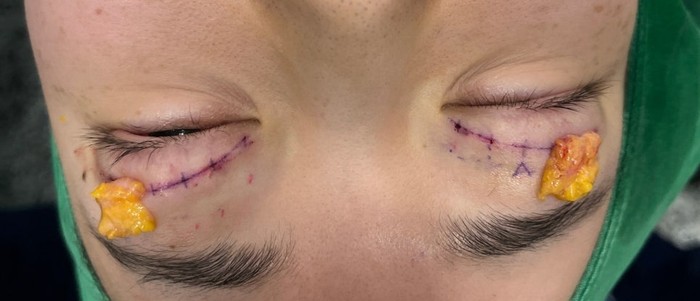
Whenever possible, a similar amount is removed from both sides.
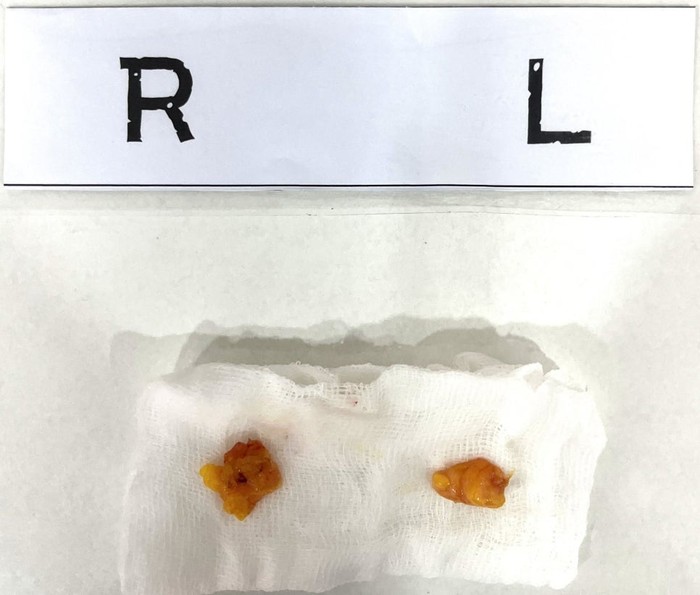
I show patients a photo of the removed fat at their follow-up visit.
Most people are surprised;;;
"Was there really that much?" they ask.
Occasionally, some people say there is not much difference whether the fat is removed or not.
But looking at the photo, it would be strange for removing that much fat to make no difference.
After all, people with sunken upper eyelids see results from fat grafting.
If the upper eyelid can be improved
by carefully removing the right amount of fat,
I don't see any reason not to do it.
Related posts
▶ Non-Incision Double Eyelid Surgery: Technique, Principle, Pros and Cons
▶ Which Eyes Are Good Candidates for Non-Incision Double Eyelid Surgery?
WhatsApp Inquiries
https://api.whatsapp.com/message/DE3GWE4FQGMDF1?autoload=1&app_absent=0
Sai Plastic Surgery — Phone Inquiries
Main Line: +82-2-512-4647
* This post was written by Dr. Kwang-rae Kang, Director of Sai Plastic Surgery, with his own text and illustrations, for the purpose of providing medical information in compliance with Article 56(1) of the Korean Medical Service Act.