



no.9
[Under-Eye Fat] Side Effects of Lower Eyelid Fat Repositioning Surgery (1)
2026-03-21
There was once an issue on social media in which a patient said
they had developed strabismus (a misaligned eye) after Lower Eyelid Fat Repositioning surgery.
In the photos the patient posted, the eye did look misaligned,
and I felt truly sorry to see it.
I imagine many people considering Lower Eyelid Fat Repositioning
are now worried, "What if that happens to me?"
So I would like to share my own thoughts
on why this may have happened.
To follow this explanation, however,
it helps to know the basic concept of Lower Eyelid Fat Repositioning
and the anatomy involved, so I am sharing that link first.
▶ Basic concept and anatomy of Lower Eyelid Fat Repositioning
First, let's look at the muscles that move the eyeball (the extraocular muscles).
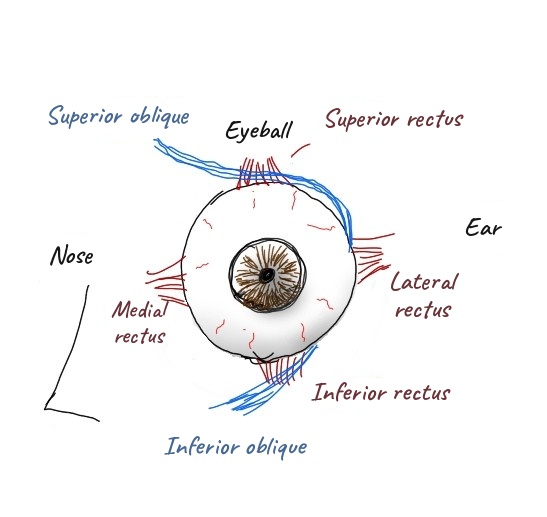
As shown above, six muscles work together to move the eyeball.
Below the eye are the inferior oblique and the inferior rectus.
The inferior rectus lies deep, so it is not encountered during surgery,
but the inferior oblique sits relatively far forward, so it can be encountered.
As shown below, while fat is being removed,
the inferior oblique may be partially injured,
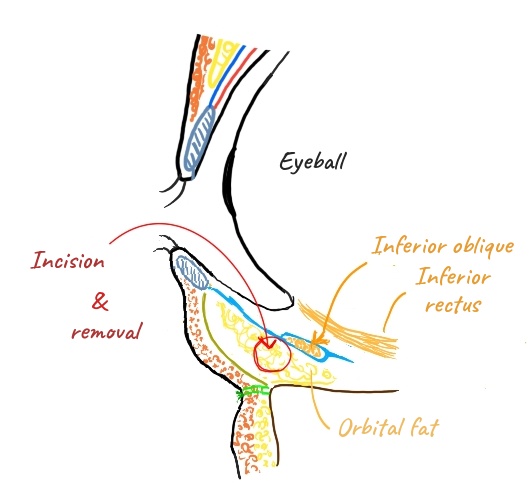
or, as shown below, during repositioning,
the inferior oblique may be pulled along with the fat and fixed in place.
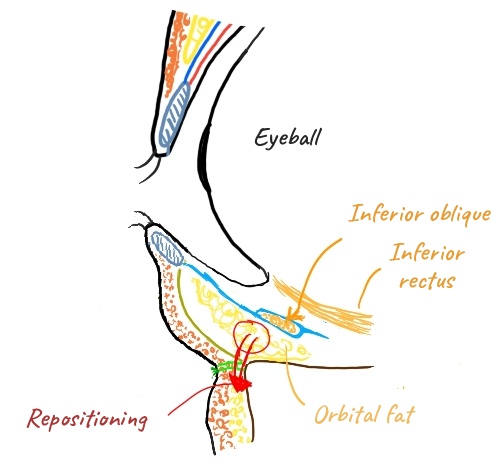
I believe strabismus can occur in either of these two situations.
However, in the second case, unless the muscle was fixed too tightly,
I expect it would gradually move back up and regain its function.
That is why, during surgery,
it is important to understand exactly where the inferior oblique lies
and to make sure it is not caught up in the procedure
when fat is repositioned or removed.
At the university hospital, I performed many orbital fracture surgeries.
In orbital fracture surgery,
we frequently encounter the inferior oblique. We either preserved it during surgery,
or, when it was absolutely unavoidable,
cut it and then reattached it.
Done this way, it does not cause problems with eye movement.
The inferior oblique is not a conspicuous tissue.
Someone who has never actually seen it
might look at it, think "What is this?"
and simply cut it.
In fact, the inferior oblique is not a main muscle for moving the eyeball.
The superior, inferior, medial and lateral rectus muscles perform the main movements,
while the superior and inferior oblique muscles play a supporting role.
So even if there is some degree of injury,
I do not think it would have a major effect on eye movement.
Looking at the patient's photos with this in mind,
I think the eye appears misaligned only when it moves toward a particular direction.
I feel deeply sorry for the patient suffering from this complication,
and I imagine it is also very difficult for the surgeon who performed the operation.
I sincerely hope the patient makes a full recovery.
I have never seen this in my own patients,
nor have I seen it among colleagues around me,
so this is an extremely, extremely rare case.
If you are considering fat repositioning,
please don't worry too much.
WhatsApp Inquiries
https://api.whatsapp.com/message/DE3GWE4FQGMDF1?autoload=1&app_absent=0
Sai Plastic Surgery — Phone Inquiries
Main Line: +82-2-512-4647
* This post was written by Dr. Kwang-rae Kang, Director of Sai Plastic Surgery, with his own text and illustrations, for the purpose of providing medical information in compliance with Article 56(1) of the Korean Medical Service Act.