



no.4
[Inner Corner] What Is Inner Corner Surgery (Epicanthoplasty)?
2026-03-16
Another surgery that is often done together with double eyelid surgery
is inner corner surgery.
In Asian eyes, the front of the eye (the inner corner, or medial canthus) is covered by skin
in the form of a Mongolian fold in many cases,
and in those cases, the eyes can look heavy
and the front of the double eyelid line looks covered, too.
This covering skin at the front is called the epicanthal fold,
or epicanthus in medical terms.
Correcting this skin through surgery
is called epicanthoplasty, commonly known as inner corner surgery.
The visible effects of inner corner surgery are
adjusting the in-line, in-out, semi-out, and out-line shapes,
and relieving the heavy feeling of the eyes.
Someone who would only get an in-line with double eyelid surgery alone
can be turned into an in-out, semi-out, or out-line with inner corner surgery,
and it can also work the other way around — it's a remarkable surgery.
Over the years, many different methods of inner corner surgery have been developed
and refined,
and they are still evolving today.
Warning: The content below is difficult — I didn't understand it even when I studied it as a resident,
so you may not follow it well,
and even if you don't, it's enough to know how the scar is left.
If it's too difficult, just scroll down to see the actual cases.
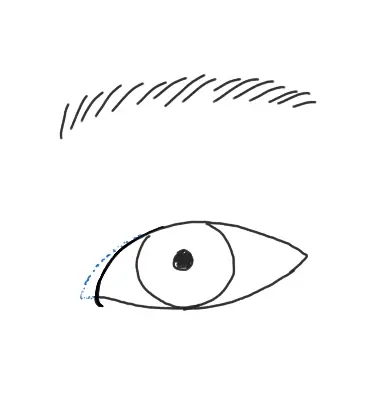 |
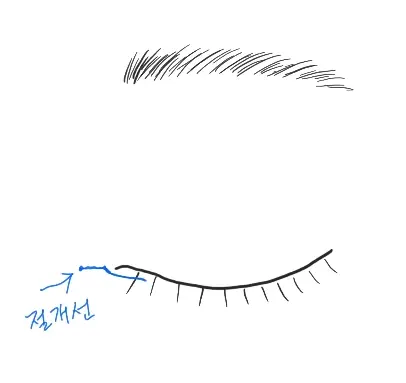
First, as you can see in the picture,
the original shape of the eye follows the blue line,
and the epicanthal fold (the Mongolian fold) covers the front
of the eye,
hanging down in a long fold toward the bottom.
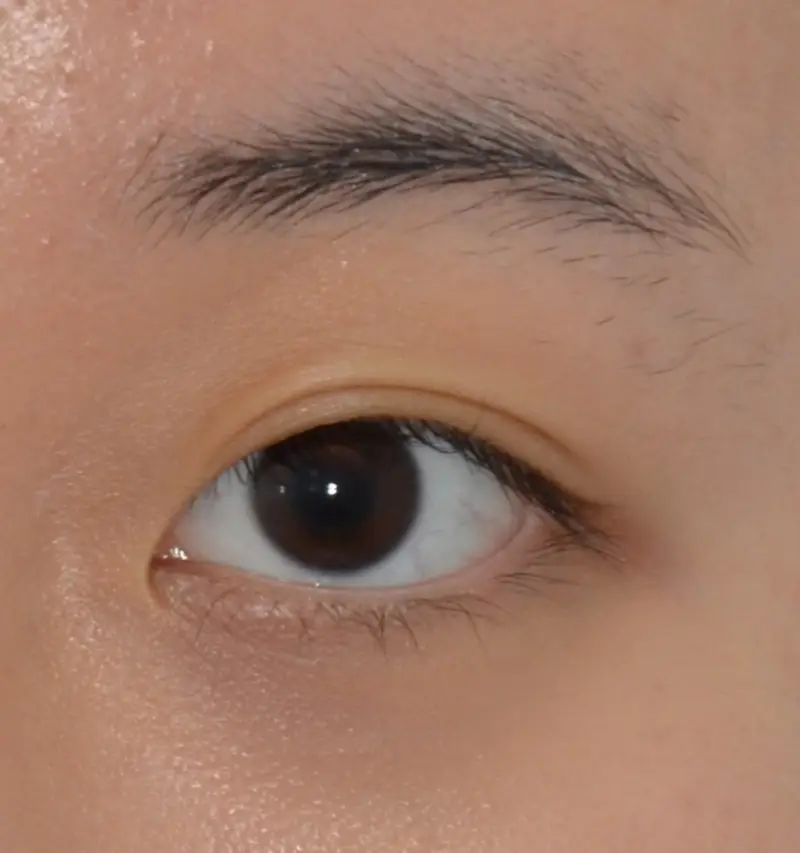 |
In a photo, it looks the same way.
Because the surgical method has to be thought of in three dimensions...
it's quite hard to explain with pictures,
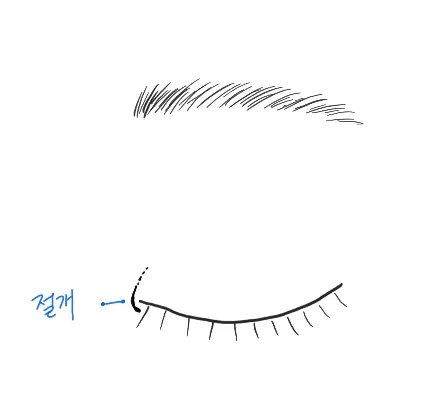 |
but first you decide how much inner corner opening to do,
mark two points as shown in the picture,
and make an incision.
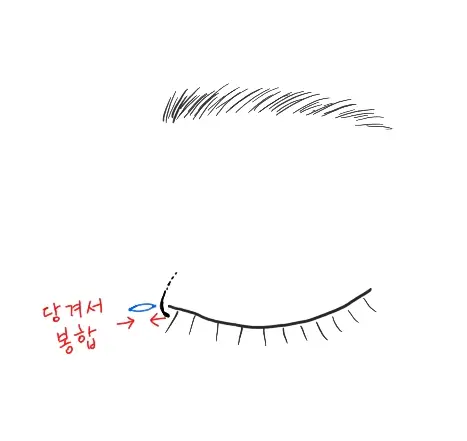 |
When you pull this together and suture it,
the skin bulges and folds up and down,
as in the picture below.
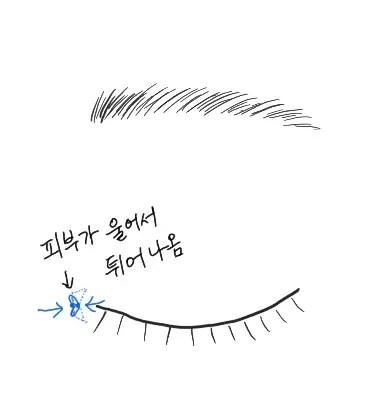 |
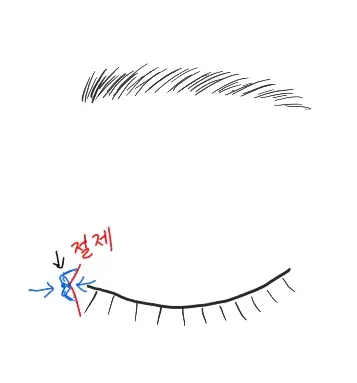 |
Then, along the direction of the red line in the picture,
the protruding skin is trimmed away neatly,
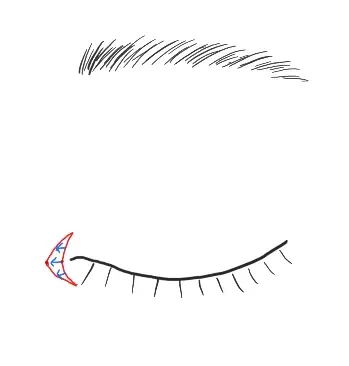 |
and when it is sutured,
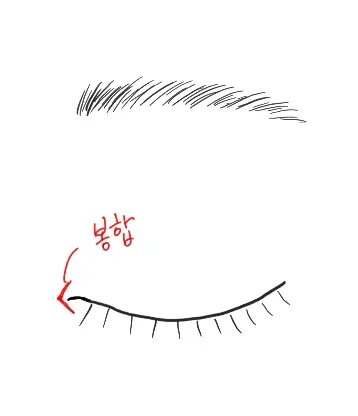 |
a scar like this is left.
This simple method
is called the Hiraga method.
It works well when only a small inner corner opening is needed,
and it has the advantage that the scar is very inconspicuous.
However, if the amount of opening is large,
the vertical scar becomes long and unsightly.
That is why
the method published in a paper by Dr. Oh Yeon-woong of Korea,
the Redraping method, is the most commonly used.
 |
In it, instead of a vertical incision on the lower side,
a horizontal incision is made from the beginning,
and the incision line runs right below the lower eyelashes.
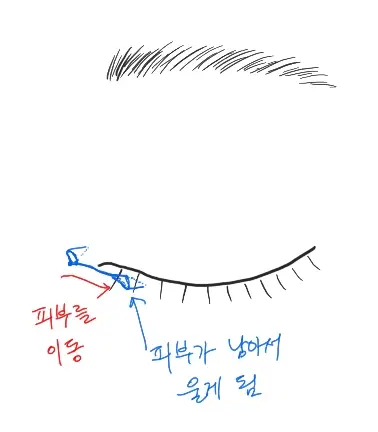 |
When the two points at the front are pulled together and sutured as above,
the skin on the upper side bulges in the same way,
while on the lower side the skin is pushed horizontally
and bulges toward the end of the incision line.
When that skin is excised and sutured in the same way,
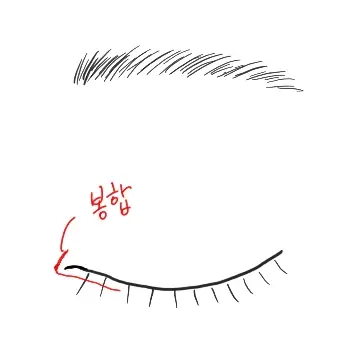 |
the suture line is left as shown in this picture,
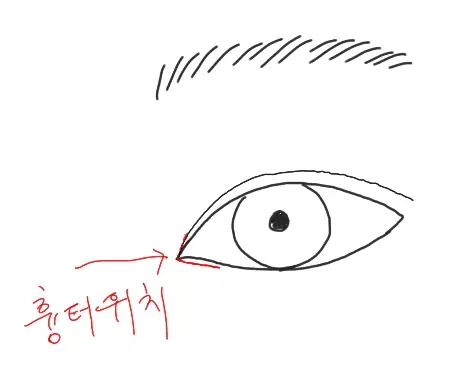 |
and then the skin that was covering the front disappears,
and the scar remains as shown in the picture.
When the scar is horizontal, it has the advantage of being less noticeable.
Depending on how the inner corner points are set
and how the skin is handled,
the method differs slightly from surgeon to surgeon.
Let's look at actual cases.
1. Hiraga method
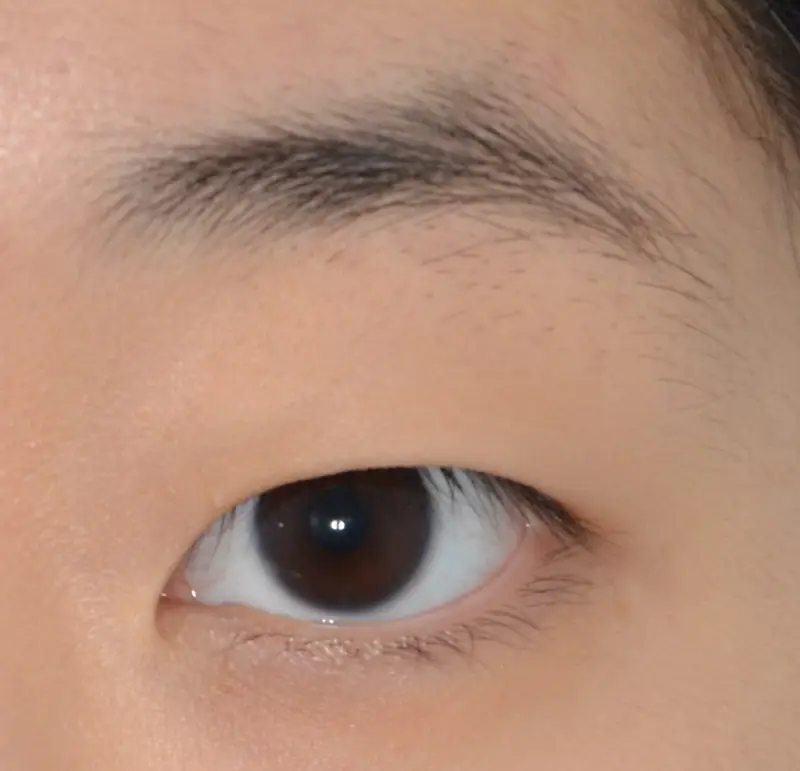 |
Before surgery, a slight epicanthal fold is visible.
The Hiraga method was used,
and to create a semi-out line, it was performed together with the double eyelid surgery,
modified into what is now called the 'upper corner opening' method,
and the surgery was carried out that way.
This is one month after surgery.
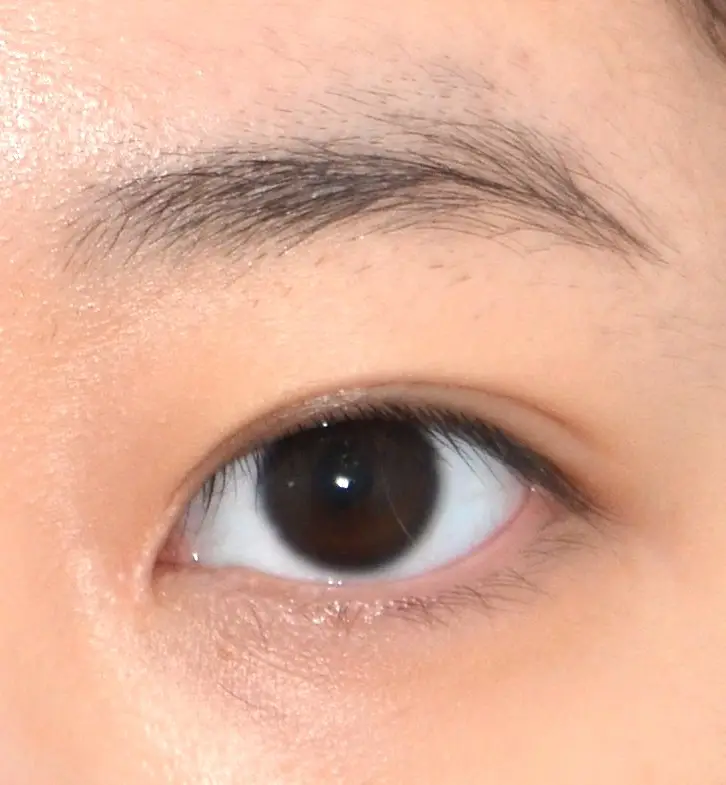 |
Along the double eyelid line, at the front,
the slightly pink and white area
is the inner corner scar.
Even at one month, it is not very noticeable.
After about six months, it will be almost invisible.
2. Redraping method
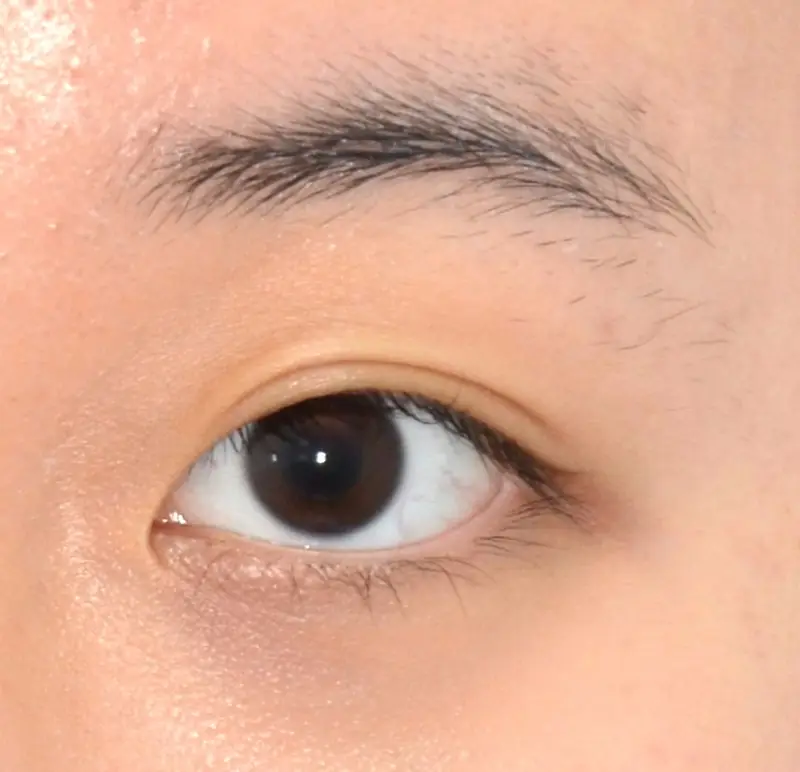 |
The Mongolian fold is quite visible, and the front looks quite covered.
To create an in-out shape,
inner corner surgery was performed together with double eyelid surgery.
This is three months after surgery.
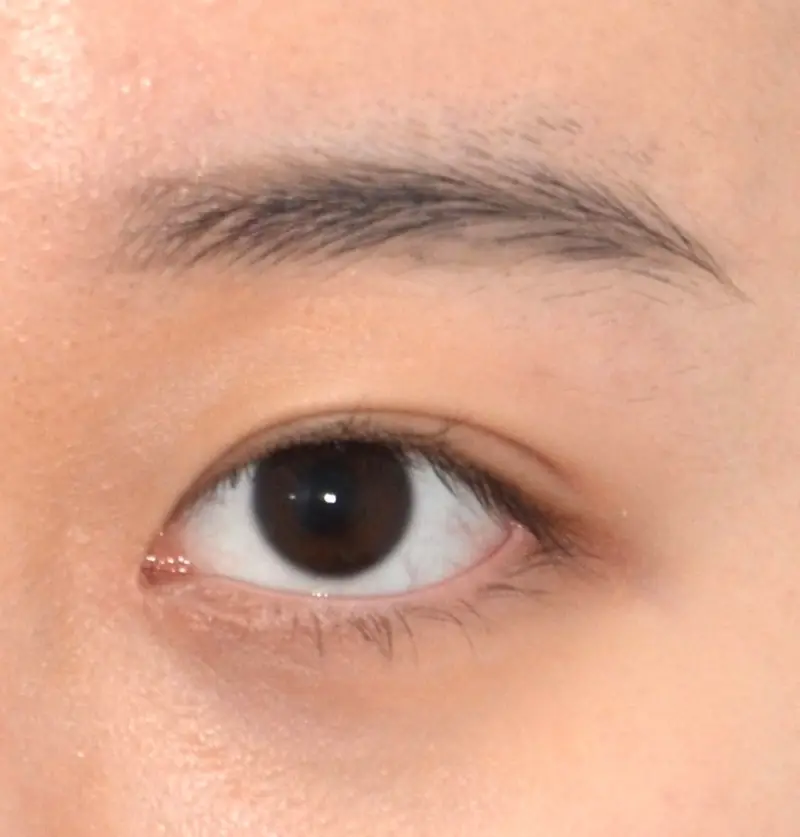 |
Redraping method inner corner surgery was performed,
the Mongolian fold has almost disappeared, and the front feels open.
The scar is faintly visible horizontally.
At this level it is slightly visible,
but it can be covered well enough with makeup.
After about six months, it is almost unnoticeable.
The change from inner corner surgery alone may not seem big,
but when it is done together with double eyelid surgery,
it makes a big change,
so it is a frequently performed surgery.
Sai Plastic Surgery — Phone Inquiries
Main Line: +82-2-512-4647
* This post was written by Dr. Kwang-rae Kang, Director of Sai Plastic Surgery, with his own text and illustrations, for the purpose of providing medical information in compliance with Article 56(1) of the Korean Medical Service Act.